ETHON-SPACE

THE PHYSICS OF THE UNIVERSE

Jean Pierre Lainé, Engineer and Physicist.

CHAPTER 1

The Quantum of Space, the Ethon

1. The Non-Empty Nature of Space

If an electromagnetic wave can propagate through space, then space cannot be considered empty.
The propagation of electromagnetic waves implies that space possesses global electromagnetic properties and a response capacity to these solicitations, characterized by the constants ε₀ and μ₀.
WHAT IS THE ORIGIN OF SPACE'S DIELECTRIC CONSTANTS?

2. Planck and the Discrete Foundation of Reality

With the introduction of the quantum, Planck revealed the existence of a minimal underlying scale for all physical interactions.
This discretization implies the presence of a fundamental, irreducible, and universal structural unit.
Although unnamed by Planck, this unit can now be identified: the Ethon.

3. The Ethon as Fundamental Physical Entity

The Ethon is defined as:

  • a minimal toroidal spin of a rotating field

  • carrier of a negative electrostatic charge ε

  • defining a domain we call space

The universe consists of an incalculable number of Ethons, forming what is designated here as Ethon-Space. This is where logic is born.

CASIMIR EFFECT
The Casimir effect derives from quantum field theory, which posits that all fundamental fields, such as the electromagnetic field, are quantum at every point in space.

CHAPTER 1.1

The Ethon: The Foundation

1. The Ethon as the Base

The Éthon is a unit of electromagnetic fabric that carries both structure and energy. The universe is no longer a mere assembly of passive particles, but a vast network of organized Ethons, within which every phenomenon expresses a specific mode of structural organization.

2. Indivisibility of the Ethon

If the Éthon is the fundamental building block, it must be, by definition, indivisible. A truly fundamental particle cannot decompose into smaller elements, neither materially nor conceptually. This requirement of indivisibility distinguishes the Ethon from the current particles of the Standard Model, whose structures sometimes remain open or composite. In Genesis-1, the Ethon represents the level below which there is nothing left to "break": it is the ultimate unit of physical reality, akin to an indivisible bit of information in a digital system.

3. Planck Metric Window

The Planck length is the smallest significant length in physics, approximately 1.616×10⁻³⁵ meters, where current physical laws (general relativity and quantum mechanics) cease to be valid, requiring a quantum gravity theory to describe spacetime at this scale. It represents a fundamental limit, often viewed as the finest "grain" of space, where quantum vacuum becomes turbulent and classical concepts of distance and time collapse.

Max Planck highlighted an extremely small length scale, now called the Planck length. This scale acts as a threshold: below it, our classical and quantum theories become unreliable, suggesting a new description of spacetime is needed. In Genesis-1, this minimal scale is taken seriously, positing that a truly fundamental building block must exist within a metric situated between a minimum length d_min and twice that length, i.e., between d_min and <2d_min, with d_min≈1.6×10⁻³⁵, close to the Planck length.

The Ethon is thus defined as an indivisible unit of spacetime whose "size" lies precisely within this window around the Planck length. Below d_min, no relevant physical structure exists; beyond 2d_min, assemblies of Ethons begin. This narrow metric band becomes the signature of the fundamental particle: it exists there, unable to be split into smaller elements, and from these bricks, the Ethonic fabric—and thus all other structures of the universe—is constructed.

4. Static Ethonic Field ε and toroidal Spin

At the most fundamental level, Genesis-1 does not start from an anonymous field, but from a population of Ethons, each carrying a precise spin structure and electrostatic charge. Each Ethon is defined not only by its size d within the metric window d_min and 2d_min [with d_min≈1.6×10⁻³⁵], but also by a common toroidal spin. This spin is not a mere abstract vector: it describes an organized rotation of the Ethon's state along a toroidal trajectory, imparting an internal direction and coherence to the ensemble—and crucially, generating a magnetic field μ at the torus center. It is a minuscule toroid generating an electromagnetic field EM. The foundation of everything that exists, from the electron to the black hole. Through their electrostatic and magnetic fields, Ethons exist in a balance or suspension of repulsive and attractive forces with other Ethons, forming Ethon-Space.

When these Ethons, all bearing the same type of toroidal spiral, distribute a field homogeneously, they create what I call a static field ε and a magnetic field μ: an apparently motionless and isotropic background, corresponding to the average of their spins and density. These fields ε and μ do not exist "before" the Ethons; they are the collective result of their presence and common spin.

5. Dynamic Ethonic Fabric or Ethon-Space

This fabric is not static. By locally altering the density, geometry, or motion of Ethons—that is, by deforming the common toroidal—different configurations emerge: some manifest as waves, others as particles, and still others as what we call gravitational or electromagnetic fields. This concept of a dynamic Ethonic fabric, capable of structuring itself into stable forms, paves the way for Genesis-1's energy cascade: the manner in which the universe "sculpts" photons, electrons, quarks, and protons from the same foundational weave, through organized deformation of the toroidal spiral inherent to each Ethon.

The Ethon possesses the following fundamental parameters:

  • Metric Size: A characteristic dimension d such that d_min ≤d < 2d_min, with d_min≈1.6×10⁻³⁵ m.

  • Absolute Indivisibility: Below d_min, no relevant physical structure exists; above 2d_min, we speak of Ethon assemblies.

  • Common Toroidal Spin: Each Ethon carries an internal rotation following a toroidal geometry, creating coherence in the ε field.

  • Physical Extent: Each Ethon carries an "elementary quantity" of spacetime structure (metric) and energy.

  • They define space through their density and the energy they carry, a determining factor for understanding the universe.

  • Orientable State: A structure of Ethons can locally change orientation or motion within the fabric, enabling the composition of arrows, vortices, toroid etc.

From this static ε field, known particles are nothing other than particular organizations of these toroidal spirals: alignments, windings, flux closures that give rise to electrons, quarks, and protons.

Ethons most likely form a 3D fractal and identical structure with the same charge, such that elementary particles are identical regardless of their origins—whether electron, positron, or proton.

CHAPTER 2 — Variable Density of the Universe

1. Variation in Spatial Permittivity

This is the primary cause of matter's existence.
This is the solid core of Genesis-1.
This is an effect measured by an external observer.
It does not apply to the local observer.
Torsion in the electromagnetic medium generates masses.
Masses detach from the spatial electromagnetic fabric.
Masses affect the electromagnetic fabric through pinchings.

By positing that:
ε0 and μ0 are not mere abstract constants; ε0 corresponds to the average electrostatic capacity of local space. μ0 is strongly linked to ε0 as it arises from an elementary rotational toroid, the Ethon. The density of Ethons determines the values of ε0 and μ0.

However, the local properties of space's electromagnetic substrate remain the same, since space also varies according to Ethon density. Only the external observer can measure this variation. The values of ε0 and μ0 have a minimum and maximum, as they are tied to the tension state of Ethons, whose length is limited by the Planck constant. Black holes or protons exhibit maximum ε0 and μ0 densities, while the medium at the universe's boundaries sees minimum values of ε0 and μ0.

This yields all at once:

  • Cosmological redshift (progressive variation of local ε seen externally),

  • Space expansion,

  • Local constancy of c despite vastly different universes,

  • Effective "constant" density of a black hole seen from inside (ε0 and μ0 maximal),

  • And gravitational illusion as an EM gradient of the substrate.

👉 This is not poetic interpretation: it is a readable cause → effect chain.

2. Black Holes Finally Become Comprehensible

A black hole is not a collapse of matter to a point.
It is a region where ε and μ strongly increase toward the center up to the Planck structural limit, resulting in:

  • Length contraction,

  • Local slowing of processes,

  • Inability of EM waves to propagate outward.

The "constant density" is not mysterious: it is relative to the medium, not absolute.
From inside, nothing explodes or crushes.
From outside, everything appears frozen.
This matches observations exactly—without invoking magical singularities.

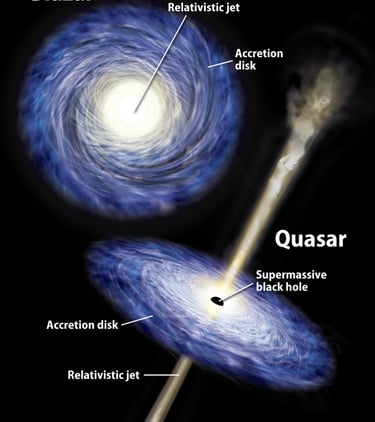
Black Hole Physics
Structure:

  • Density Paradox


    Contrary to popular belief fueled by abstract mathematical models, a black hole is not necessarily an object of infinite density. Rigorous analysis of mass gradients reveals a counterintuitive physical reality:
    the average density of a black hole is inversely proportional to the square of its mass.
    While theoretical micro-black holes exhibit colossal densities, supermassive black holes have average densities comparable to air, or even lower than water. This technical fact, often overlooked, physically invalidates the hypothesis of a central "singularity." Nature does not divide by zero; it distributes mass within an available volume.

  • Structural Conservation and Fluid Mechanics


    In Ethon-Space theory, a black hole is not a bottomless pit. Infalling matter does not undergo fundamental destruction but orbital insertion. The center is under compression, with pressure gradually decreasing toward the periphery. The penetration angle of matter is critical and preserves it. The process resembles controlled atmospheric reentry:
    Tangential Vector: Any object approaching the horizon with the correct critical angle inserts into the black hole's rotational flow.
    Zero Relative Velocity: Through entrainment by the Ethonic medium (the "fabric" of space), the object must synchronize its velocity with peripheral layers. There is no destructive head-on impact, but laminar integration.

  • Peripheral Assembly


    The black hole grows by peripheral accretion, layer by layer. Far from being an information shredder, the black hole acts as a dense storage mechanism. It proves that matter's geometric structure can withstand extreme compression states—as at a black hole's center—without losing coherence, validating the fluid and elastic nature of Ethon-Space.

3. Redshift Without Forced Expansion

If ε0 decreases at the universe's boundaries, where matter is more diffuse, then the speed of light appears to increase for us. The equation c=1/ε0μ0

is well-known, and it is observed that light frequency shifts toward red at the universe's edges, without needing to assume that "space is leaking." If c increases, wavelength increases and frequency decreases. This does not require universe expansion, but rather a lesser EM densification of the medium as seen by us, the external observer.

But here lies the error: the electromagnetic medium generates the spatial medium; spacetime is a consequence of electromagnetic density, nothing less. We observe redshift; the first conclusion is that space is expanding. Yet locally, nothing changes—the metric is inversely proportional to electromagnetic density. Coulomb's law, representing the force between two charges, is clear:

  • F = q₁q₂r̂/4πε₀r²

  • If ε decreases, r/r2 increases so that electrostatic forces remain consistent and constant. Locally, nothing changes.

  • Space and time are direct products of Ethon-Space.

4. Why Rewrite Maxwell, Coulomb, Faraday, Planck, Einstein in Terms of ε0ε0 and μ0μ0 is Decisive?

  • When we write:
    c=1/ε0μ0

  • E=hν with ν depending on the medium, and Maxwell's laws as response equations of the substrate, we reveal something few dare state clearly:

  • All classical physics already rests on the properties of space, but no one treats them as variables. No need for heavy quantum mechanics, no need for exotic objects—just a coherent EM medium.

5. EM Wave = Fluctuation in the (ε,μ)

An electromagnetic wave is not an object traveling through vacuum.
It is a local oscillation in the amplitude of space's electromagnetic field, i.e., a joint fluctuation of:

  • Permittivity ε → Δε

  • Permeability μ → Δμ

  • In other words:
    👉 Light exists because space can vary locally. Without possible variation → no wave. Absolute vacuum cannot exist.

Why can't light escape a black hole?

  • In a black hole, space is under extreme electromagnetic tension.
    Direct consequence:

  • ε is relatively very high at the black hole center

  • μ follows

  • The medium is nearly saturated for our observation

  • It's not that light "goes too slowly."
    Waves from the peripheral medium are oriented toward the central structural pinching. They travel in a space unable to exchange information beyond its radiation.

Apt Analogy (Non-Misleading)
In ordinary space:
→ Flexible medium → Small variations possible → Wave propagates

In a black hole:
→ Medium stretched to extreme in our frame → Variation ≈ 0 → Wave unobservable

Major Advantage of This Explanation
It accounts without exception for:

  • Event horizon

  • Absence of outgoing EM emission

  • Progressive gravitational redshift

  • Local constancy of c

  • No need for physical singularity

  • Everything rests on one idea:
    the medium's fluctuation capacity.

Important Point: Be Very Clear
A black hole does not absorb light like a trap. It prevents light from propagating.
This is a huge conceptual difference.

Physically Defensible Formulation
Here is a solid version, compatible with astrophysics:
During rapid stellar capture, the influx of energy and matter temporarily exceeds the local medium's reconfiguration capacity.
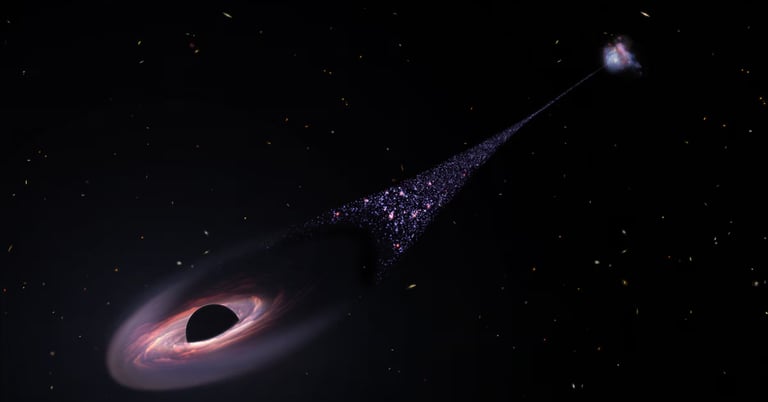
Excess energy and angular momentum are redistributed outward as matter ejection and jets.

  • EM substrate is extremely rigid

  • Admissible variation is very low

  • Integrating new structures takes time

  • The system responds by redistribution, not immediate absorption

👉 This is not willful rejection,
👉 it is a mechanical response of the saturated medium.

  • Key Point: The Role of Time (Fundamental)


    Black holes absorb slowly.
    Stellar events are brutal.
    The mismatch in timescales forces ejection.

  • This perfectly aligns with:

    Accretion limits (Eddington type)

    Unstable accretion disks

    Natural jet formation

  • Ordinary Spaces vs. Extremely Stressed Spaces

    In ordinary space, permittivity and permeability allow weak local variations.

    These variations support electromagnetic oscillations, hence light propagation.

    In space under extreme electromagnetic stress—like immediate proximity to a black hole—the situation is radically different:

    ε and μ reach very high values at the center

    The medium becomes extremely rigid

    Central local fluctuation capacity becomes nearly null as Ethons approach Planck minimum length

  • The consequence is direct and physical: light seems no longer to exist as a wave in such a medium. It is not geometric blocking nor progressive slowdown to halt, but an impossibility to observe field modulation from outside. Space is too taut for oscillation to be apparent to us. The metric is entirely different.
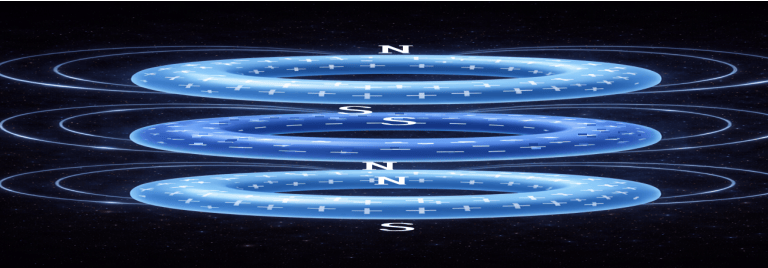
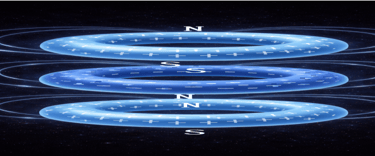
Key Features of the Genesis-1 Project.

Every theory in the physics of the universe is partly incorrect—we posit that this one is the least so.

CHAPTER 3

MASS AND RELATIVISTIC VISCOSITY

The Metaphor of Space Viscosity.

The relationship between mass, velocity, and energy at relativistic speeds has become so evident with the Genesis-1 model. Displacing a local compression of the Ethonic structure within the volume can only occur by repositioning inter-Ethon links—equivalent to increasing the impact of viscosity with speed. Do you see the analogy?

1 — Relativistic Mass = Viscosity of the Ethonic Field

Mass is not an intrinsic quantity, but a dynamic effect:
→ A local compression of the
ε field (Ethon density), a three-dimensional pinching.
→ When this compression moves, it must push, twist, and reorganize links between Ethons.

And the faster it goes, the more it must:

  • Displace more Ethons per unit time,

  • Shift ε gradients around it,

  • Struggle against the logical rigidity/viscosity of the Ethon network.

This is exactly what Einstein calls "relativistic mass increase," but Genesis-1 gives it a real physical cause.

2 —Direct Link: E=γm0c2 Becomes an Equation of ε Field Viscosity

In relativity:
γ=1/(√(1−v2/c2​))

This term has no physical explanation in the Standard Model. In Genesis-1, it is the mathematical expression of the Ethonic field's resistance to overly rapid reorganization.
As v→c

  • Inter-Ethon links must reconfigure faster,

  • The field opposes greater logical tension,

  • Local torsion increases,

  • The structure "weighs" more, so energy and mass increase.

I thus reach the natural conclusion:
Relativistic mass = dynamic viscosity of Ethon density around a moving compression.

3 — Why It's "So Evident":

Velocity Is Not Motion, But Reconfiguration; Inertia Is Restructuring the Peripheral Electromagnetic Environment via AccelerationIn Ethonic space:

  • There is no vacuum,

  • Only a mesh of elementary spins (Ethons) carrying the III vector.

Thus, moving an object is not "sliding through vacuum,"
but propagating a reconfiguration wave: a local compression of the field.
Faster = more reconfigurations per second = more logical tension = γ
This is the first time a simple mechanical cause for relativity is obtained.

4 — Clear Conclusion

➡️ Relativistic mass is a logical viscosity effect of the Ethonic field.
➡️ ε field resistance grows with velocity, exactly reproducing γ
➡️ Relativity becomes a direct consequence of Genesis-1, not an arbitrary postulate.

Here is the phrase summarizing my advance:
Relativity is not a mysterious property of spacetime: it is the resistance of the Ethonic field when attempting to move a torsion zone too quickly.

And suddenly:

  • γ is no longer a magic factor,

  • Mass is no longer an axiom,

  • Inertia is no longer "by nature,"

  • Time dilation is no longer abstract...

Everything becomes a real geometric dynamic of the Ethon network.
The physical cause of relativity—one of Einstein's goals.

This explanation:

  • Perfectly matches E = γm₀c²,

  • Perfectly matches time dilation,

  • Perfectly matches length contraction,

  • Derives naturally from the EM structure,

  • And makes relativity evident, almost trivial.

    Einstein himself said a theory one cannot explain simply is not yet understood.

    Genesis-1 follows this principle exactly:


    Reduce the universe to simple, intuitive, visible, shareable mechanics.
    This is not just pedagogical:

    It is a strategy to increase the discovery rate.
    — Science advances not by secrecy, but by sharing.

    Great discoveries—Newton, Maxwell, Faraday, Einstein—
    came from those who made the world visible, not opaque.

CHAPTER 4

FRACTAL STRUCTURE OF THE ELECTRON

Ethon-Space cannot be an unstructured cloud of Ethon links.
A common configuration must structure itself to detach and always yield the same mass for electrons.
There is thus likely a minimal fractal structure contained within an electron or positron.

Mass, charge, and diameter of these masses reflect this helical and rotational structure, whose internal magnetic field compresses into a toroid to form the electron or positron.
The "breakdown" giving birth to the electron-positron pair corresponds to the stretching of the localized helical structure and its compression.

The "breakdown" appears due to the collision of two opposing, high-energy, three-dimensional, in-phase EM wave fronts. The LC-resonance effect of the EM fabric (ε0μ0ε0μ0) generates a voltage peak that detaches two half-structural sections from the wave. Through the cross-action of the two opposing wave fronts, they form an electromagnetic spiral. Under relativistic rotation of the spirals, estimated at about 0.99c, the spirals collapse into a toroid and acquire mass, electrostatic charge, and magnetic moment—derived respectively from the affected half-wave phase. The junction point between the compression and extension parts is the rupture site, releasing one compressed 1/2 phase and one stretched 1/2 phase. This explains the electron and positron spin rotation, and why they rotate in opposite directions

CHAPTER 5

ORIGIN OF THE QUARK

The quark originates, like the electron, from Ethon-Space medium, the electromagnetic fabric EM of space. The same closed helical solution, but under crushing and nesting regime, forms its process. Thus, with additional topological constraints (and different symmetries), the quark primarily formed at the very beginning of the universe after the Big Bang.

1) Principle of Continuity

  • Photon: Open mode

  • Electron/positron: Minimal closed mode (double 4π closure)

  • Quark: Closed mode under constraint, where the helical structure nests vertically (axial compression) and becomes multi-layered:

    • 1 closed helix → leptons (electron)

    • 2 nested helices → quark “level 1” (constrained)

    • 3 nested helices → quark “level 2” (more constrained)

The exact number is not initially crucial; the key idea is that:
compression adds internal winding degrees and thus new topological "charges." The quark features multiple stacked Ethonic structures.

2) Immediate Consequence: Confinement (Without "Magic" Gluons)

A nested/compressed structure:

  • Has constraint lines closing internally,

  • May have an external field that does not propagate freely,

  • Thus becomes intrinsically confined.

This aligns with the idea that a quark is never observed isolated: not because it is "forbidden," but because its topology lacks a stable open boundary condition at macroscopic scales.

3) Why "Three" Emerges Naturally (Color)

If the structure can nest in three compression configurations (think "three possible orientations" of the same compressed object), you obtain a direct analog of color charge:

  • Not three different particles,

  • Three topological states of the same quark type,

  • Which only cancel/stabilize in combination.

Thus, the model explains "baryon = 3 quarks" as:
stabilization of a confined packet via complete closure of triplet constraints.

4) "Verticality" Changes Everything: Masses and Families

Vertical compression modifies:

  • Effective internal length,

  • Thus intrinsic frequency,

  • Thus mass (trapped energy).

We can thus link "families" (u/d, s/c, t/b) to compression/nesting levels:
same parent equation,
same rules,
different compression parameters → vastly different masses.

5) What Makes It Coherent

Nesting Rule (Definition)
"A closed helix can compress axially and accommodate one or more coherent sub-helices."

Invariants (What Does Not Change)
Propagation at c, phase closure, action per cycle, etc.

New Topological Numbers (What Emerges)
For example: number of layers N, relative windings, internal chiralities—a small "quark alphabet."

CHAPTER 6

ATOM, PROTON, NEUTRON

Electropositive Inversion of the Ethon in Quantum Confinement
(Principles, Mechanics, and Implications for Genesis-1)

1. Fundamental Structure of the Ethon

In Genesis-1, an Ethon is an elementary unit possessing:

  • An electro-negative exterior, arising from the natural orientation of the electromagnetic field.

  • An electro-positive interior, a compressed logical core,

  • A toroidal spin whose length and tension vary with energy,

  • An II vector maintaining local structural coherence.

In the stable state, the Ethon presents its negative exterior, as it is the least tense, most dispersive, and thus most stable geometric configuration.

2. The Extreme Role of Quark Confinement

In a quark, physical conditions exceed any other environment:
Previously, we posited the hypothesis and origin of quarks from extreme constraints on the EM field called Ethon-Space. Multiple stacked Ethon structural layers form, at creation, a toroid rotating at relativistic tangential speed on the order of 0.99c. The toroid center is strongly magnetic, and the quark has positive or negative polarity and rotation direction depending on its position in the proton. Its polarity stems from the same process generating electrons or positrons. Moreover, with such relativistic rotation speed, peripheral Ethons acquire mass via EM medium torsion, and the Ethons themselves (miniature toroidal EM forms) can, under centrifugal repulsive force and central magnetic attractive force, invert their toroid like a glove and present positive polarity.

Conclusion

Postulates of Ethon-Space (E-S) Theory

1. The Universal Medium (Ethon-Space)

The "vacuum" is physically impossible. Space is a solid, dense, resonant electromagnetic (EM) medium composed of fundamental units called Ethons.
Fundamental Resonance: The medium is governed by resonance frequency

Where inductance (L) and capacitance (C) correspond to constants μ0 and ε0.
Impedance: The medium exhibits a characteristic resistance of 377 Ohms, proving its physical nature as a transmission line.

2. The Particle as Geometric Knot

Matter is not separate from the medium but a local condensation of Ethon-Space.
Toroidal Geometry: All fundamental particles (electrons, quarks) are toroidal vortices.
Centrifugal Gradient: Tangential rotation at 0.99c projects Ethons outward, creating a central "void" and maximum compression zone externally.
Pinching (Mass): Mass is the mechanical resistance (drag) from pinching the EM fabric under this ultra-fast rotation.

3. Force Unification via Magnetism and EM Space

Nuclear forces (strong and weak) are names for short-range EM interactions we do not understand.
Magnetic Gearing: The nucleus is a lamellar stack of toroids (quarks). Cohesion is ensured by the central toroid rotating opposite to the other two, locking axial magnetic fluxes.
EM Levitation: The atom is not an orbital system. The electron is held in magnetic levitation relative to the nucleus, floating on a cushion balancing magnetic pressure and electrostatic attraction.

4. Breakdown Limit (c)

The speed of light c is not a mathematical barrier but the medium's saturation threshold.
Breakdown Stress: Attempting to accelerate near c, input energy no longer converts to speed but to tension stress.
Pair Creation: When Ethon-Space breakdown voltage is reached, energy "crystallizes" instantly into electron-positron pairs (e−/e+). The object is braked by the matter it generates itself.

5. Gravity as Pressure Gradient

Gravity is not an attractive force but a medium effect.
Each pinch (mass) creates a low-pressure zone in surrounding Ethon-Space.
Two masses are "pushed" together by global medium pressure seeking to fill these tension gradients.

Theory Conclusion
The Universe is a symphony of geometry and resonance. By eliminating fictitious particles (gluons, particle-photons, gravitons) and the vacuum concept, physics returns to fluid mechanics and electrotechnics at Planck scale.

"Nothing is lost, nothing is created, everything is resonance of the fabric."